
Parotid
Recurrent Parotid Tumour: Why It Returns and How Revision Surgery Works
You had your parotid tumour removed and thought it was over. Then, months or even years later, you feel a new small lump near the scar. The first thought is often, "Did the surgery fail?"
You had your parotid tumour removed and thought it was over. Then, months or even years later, you feel a new small lump near the scar. The first thought is often, "Did the surgery fail?"
In most cases, a recurrent parotid tumour does not mean something went terribly wrong. It is a known problem, mostly linked to one type of tumour, and it can be treated. But it needs careful handling, because a second operation is more delicate than the first. This guide explains why these tumours come back, which signs to watch for, and how revision parotid gland surgery is done while protecting the facial nerve.
What Is a Recurrent Parotid Tumour?
A recurrent parotid tumour is a tumour that grows again in the same area after it was removed. It may appear as one lump, or as several small lumps in the scar or in the gland tissue that was left behind.
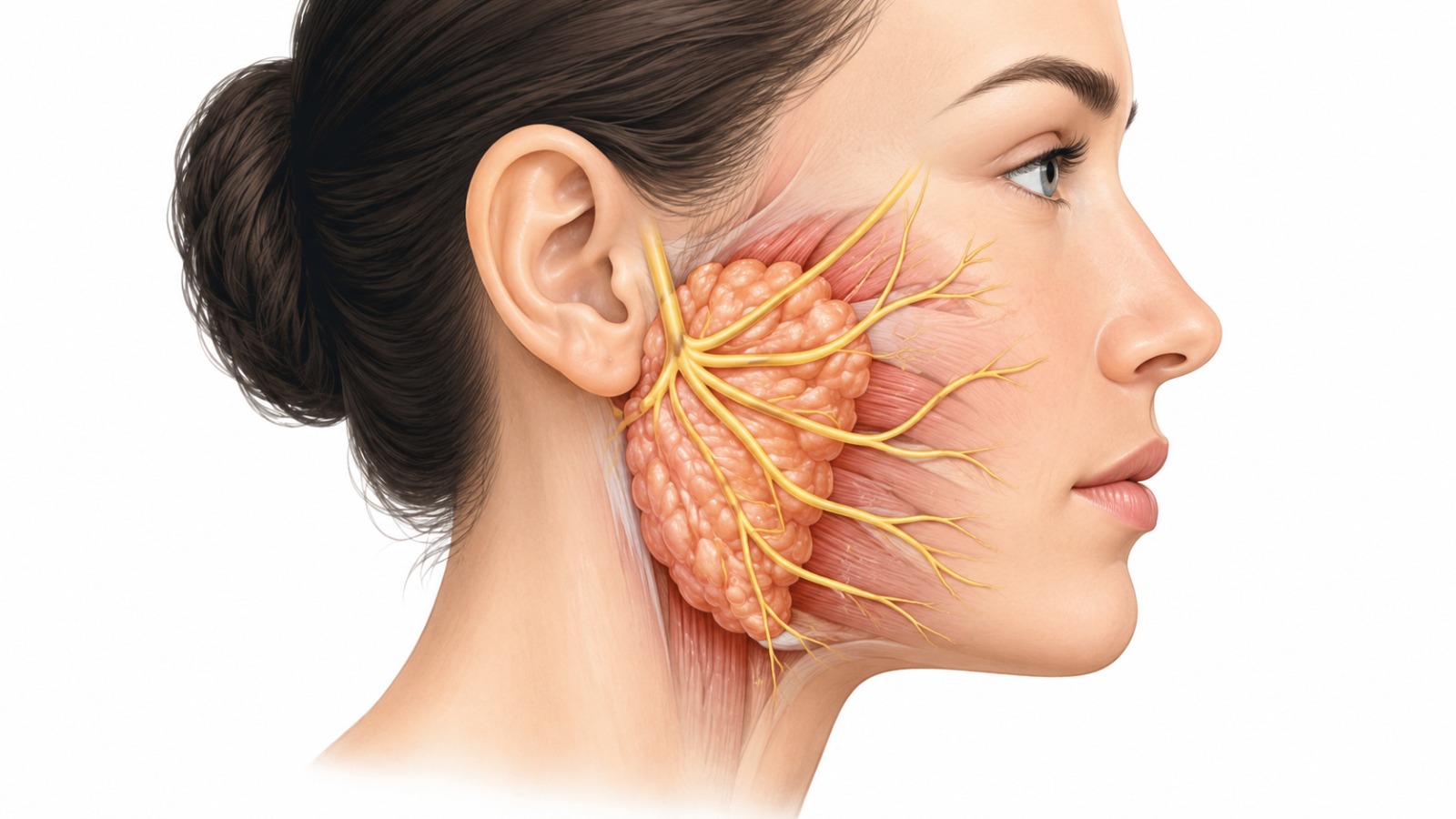
The parotid gland sits in front of and below the ear, and the facial nerve runs right through it. That is why every parotid operation is really an operation to protect that nerve.
Most recurrences involve pleomorphic adenoma, the most common benign tumour of this gland. Warthin's tumour can also appear again, but it is often a new tumour rather than a true recurrence, because it can grow in more than one spot. Parotid cancers can come back too, and how they behave depends on the type and grade of the cancer.
If you are not sure what caused your original swelling, our blog on non-cancerous parotid swelling causes and diagnostic tests explains the common reasons.
Why Do Parotid Tumours Come Back?
A pleomorphic adenoma has a thin, uneven covering called a capsule. In some places, tiny finger-like pieces of tumour grow through or beyond it. If surgery only shells out the visible lump, or if the tumour breaks open during the operation, small cells can be left behind and slowly grow again.
| Cause | What happens | How it is reduced at the first surgery |
|---|---|---|
| Thin or incomplete capsule | Tumour cells sit just outside the visible edge | Remove the tumour with a margin of normal gland |
| Shelling out the lump | Tumour is left behind at the edges | Choose the right operation for the tumour type and location |
| Tumour spill during surgery | Cells fall into the surgical area and grow as many small nodules | Gentle handling to avoid breaking the tumour |
| Deep lobe or hard-to-reach tumour | Part of the tumour is missed because it is hard to see | Careful MRI planning and an experienced surgeon |
| Aggressive tumour type | Cancer cells spread along nerves or nearby tissue | Wider removal, neck dissection and radiotherapy when needed |
Recurrence can be slow. A pleomorphic adenoma may grow back after many years, which is why long-term follow-up matters even when the first surgery went well.
Signs of a Recurrent Parotid Tumour
Please book a check-up if you notice any of these after parotid surgery:
- A new lump, or several small lumps, near the scar or in front of or below the ear
- Firm, painless nodules that slowly get bigger
- A lump that grows quickly, turns hard or becomes painful
- New weakness or drooping on the operated side of the face
- Numbness or skin changes over the area
- Swollen lymph nodes in the neck
Not every lump after surgery is a recurrence, since scar tissue can feel like one too. But a lump that stays or keeps growing should always be checked.
Red flag: Rapid growth, pain or new facial weakness can point to a more serious problem, including cancerous change. Do not wait if you see these signs.
How Doctors Diagnose a Recurrence?
Doctors usually start with your old operation notes and pathology report, which show the tumour type, whether the edges were clear and whether the tumour broke open. Please carry them with you.
Next comes an examination of the lump, the scar, the neck and each branch of the facial nerve, followed by an ultrasound with a needle sample (FNAC) to check whether the lump is benign or cancerous. An MRI then shows how many nodules are present, how deep they are and how close they sit to the nerve. If cancer is suspected, a CT scan or PET-CT may be added.
Can a Recurrent Parotid Tumour Turn Into Cancer?
Most recurrent pleomorphic adenomas stay benign. But tumours that have been present for many years, or that come back more than once, carry a small risk of cancerous change. This is why a recurrence should not be ignored.
Revision Parotid Gland Surgery: What Is Different the Second Time?
Revision surgery is harder than the first operation. Scar tissue hides the normal layers of the gland, and the facial nerve may be pulled out of its usual position or stuck within the scar. The surgeon has to work slowly and with more care.
| Point | First surgery | Revision surgery |
|---|---|---|
| Tissue layers | Clear and natural | Blurred by scar tissue |
| Facial nerve | Found at the usual starting point | May be shifted or buried in scar, so it needs a careful search |
| Operating time | Usually shorter | Often longer |
| Chance of temporary facial weakness | Lower | Higher |
| Main goal | Remove the tumour with a margin | Remove every nodule and at-risk tissue while protecting the nerve |
How the Operation Is Planned and Done
- The surgeon studies your old reports and MRI before the day of surgery
- Continuous facial nerve monitoring alerts the surgeon when an instrument comes close to a nerve branch
- The nerve is located in an area less affected by scar, then followed carefully
- All visible nodules are removed with a margin of surrounding tissue
- Remaining gland tissue, and in some cases the scar or involved skin, may also be removed
- If a cancer has invaded the nerve, the nerve may need to be reconstructed with a graft
At the end, the surgeon may use a fat graft or a flap to restore the shape of the face and lower the chance of sweating over the cheek while eating, known as Frey's syndrome. You can read about these options in our guide on reconstructive surgery.
Is Radiotherapy Needed?
Not always. It may be considered when the tumour has come back more than once, when cancer is found, or when complete removal is not possible.
Risks and Recovery After Revision Surgery
Every surgery has risks, and revision surgery carries a few more than the first one. Your surgeon should explain these clearly before you decide.
- Temporary facial weakness: more common than after a first operation. It usually improves over weeks to a few months. Eye drops are advised if the eye does not close fully.
- Permanent facial weakness: a smaller but real risk. Our blog on whether parotid gland surgery can cause facial weakness explains this in detail.
- Ear numbness: common and often long-lasting, though it rarely causes trouble.
- Frey's syndrome: sweating on the cheek while eating, in some patients.
- Slower wound healing: scarred tissue may heal more slowly.
- Another recurrence: possible, which is why follow-up is important.
The hospital stay is short, with a small drain removed after a day or two, and may be a little longer than after a first operation. Many people return to light activity in one to two weeks, though this varies. Follow-up visits and scans continue for years.
Can You Prevent a Recurrence?
The best way to lower the chance is to get the first operation right. If you are planning your first parotid surgery, ask whether the tumour will be removed with a margin of normal gland, whether facial nerve monitoring will be used, and whether you will get a copy of the pathology report.
After surgery, keep all your reports safe and go for regular check-ups, even if you feel completely fine.
Seeing a Specialist for a Recurrent Parotid Tumour
A recurrent parotid tumour is best handled by a surgeon who does parotid surgery regularly and understands the facial nerve well.
Dr. Parin Patel is a fellowship-trained head, neck and skull base surgical oncologist at HCG Aastha Cancer Centre, Sola, Ahmedabad. His skull base training at Tata Memorial Centre helps with deep and hard-to-reach tumours. He uses nerve monitoring and magnification for parotid operations, and plans cancer cases with the tumour board. You can read more about his practice on the page for a head and neck cancer surgeon in Ahmedabad.
Patients come from other cities too. Keep your first operation notes, pathology report and latest scans ready. To book a consultation, call +91 76985 60626 or contact the clinic, and ask how to share your reports before you travel.
Frequently Asked Questions
Can a parotid tumour come back after surgery?
Yes. It is most common with pleomorphic adenoma, especially if the tumour was not removed with a margin or broke open during surgery. It can appear months or many years later, so long-term follow-up is advised.
Is a recurrent parotid tumour always cancer?
No. Most recurrent pleomorphic adenomas are still benign. But a long-standing or repeated tumour has a small risk of turning cancerous, so it should always be checked.
Does revision parotid surgery always cause facial weakness?
No. Temporary weakness is more common than after a first surgery, but many patients recover well. Nerve monitoring and careful technique help lower the risk. Permanent weakness is less common, and your surgeon should discuss it with you beforehand.
Can radiotherapy be used instead of a second surgery?
In most benign recurrences, surgery is the main treatment. Radiotherapy may be added in selected cases, such as repeated recurrence or cancer. The plan depends on your reports and scans.
Can a recurrence be prevented?
The risk can be lowered by a complete first operation with a margin, careful handling of the tumour and regular follow-up. It cannot always be reduced to zero.
Final Thoughts
A parotid tumour that comes back is stressful, but it is a known problem with clear treatment options. Get it checked early, bring your old reports, and choose a surgeon who handles the facial nerve with care.
This article provides general medical education and does not replace an individual examination or treatment recommendation.