
Reconstructive Surgery Specialist in Ahmedabad
Reconstructive surgery in Ahmedabad that rebuilds form and function after head and neck cancer.
Removing a head and neck cancer completely can leave a defect in the jaw, tongue, cheek or throat. Reconstructive surgery, performed in the same operation, rebuilds these structures using tissue from elsewhere in the body so patients can speak, swallow and face the world with confidence. Dr. Parin Patel plans resection and reconstruction together from the outset.
Clear decisions
Function-conscious planning
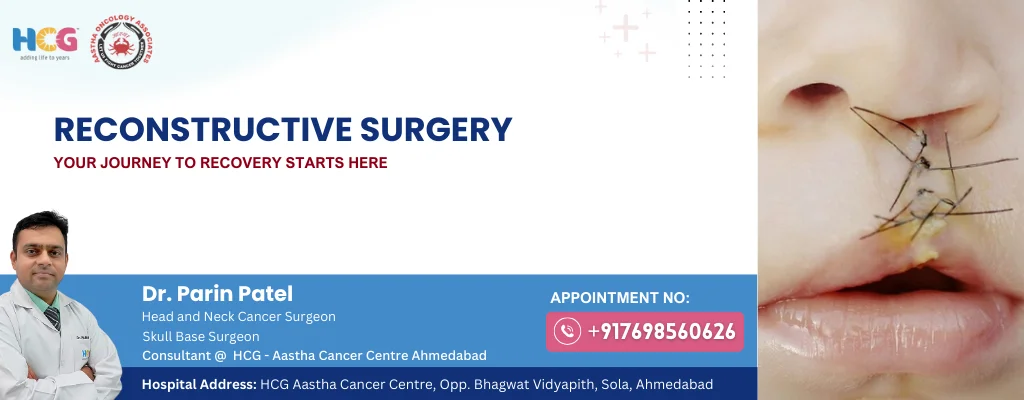
What is head and neck reconstructive surgery?
Curing a head and neck cancer means removing it with a margin of healthy tissue. In the mouth, jaw, face and throat, that margin may include the structures we use to eat, speak, breathe and express ourselves. Reconstructive surgery replaces what has been removed with living tissue from elsewhere in the patient's own body, restoring shape and function. It is not a cosmetic afterthought: reconstruction is what makes complete, curative cancer surgery possible without leaving patients unable to swallow or with a disfigured face.
Dr. Parin Patel's principle is that the resection and the reconstruction are one operation. The defect is anticipated from the scans, the reconstruction is chosen before surgery, and the two are performed in the same anaesthetic, so that patients wake with the jaw, tongue or cheek already rebuilt.
Who needs reconstruction?
- Patients having surgery for oral cancer, mouth cancer or tongue cancer, where part of the tongue, cheek, floor of mouth or jaw is removed
- Patients having a segmental mandibulectomy or maxillectomy for cancers invading the jaw or palate
- Patients having throat or laryngeal surgery where the swallowing passage must be rebuilt
- Patients with paranasal sinus and skull base cancers, where the barrier between nose and brain and the facial contour are reconstructed
- Patients with skin cancers of the face and scalp, or defects after parotid surgery
- Patients with facial trauma or defects from previous surgery seeking craniofacial correction
- Patients whose previous reconstruction has failed or who have complications after radiotherapy, such as exposed bone
Reconstructive techniques
Reconstruction follows a ladder, from the simplest method that will do the job to the most complex. Dr. Patel selects the technique according to the size and location of the defect, the tissues removed (lining, muscle, bone, skin), whether radiotherapy will follow, and the patient's general health.
Free flaps used in head and neck reconstruction
- Radial forearm flap: thin, pliable skin for the tongue, floor of mouth, cheek lining, palate and pharynx
- Anterolateral thigh flap: larger, adaptable skin and fascia for cheek, tongue, throat and skull base defects, with a concealed donor scar
- Fibula flap: a length of leg bone with skin for rebuilding the lower jaw or upper jaw, strong enough to hold dental implants
- Iliac crest and scapula flaps: alternative bone sources for jaw reconstruction
- Jejunal flap: a segment of small bowel for circumferential reconstruction of the pharynx
What reconstruction restores
- 01
Swallowing and eating
A rebuilt tongue, palate or pharynx keeps food moving safely from mouth to oesophagus. A reconstructed jaw with implants restores chewing.
- 02
Speech
A mobile, appropriately sized tongue and an intact palate are what make clear speech possible. Free-flap reconstruction, followed by speech therapy, achieves intelligible speech in the great majority of patients.
- 03
Facial appearance
Restoring the contour of the jaw and cheek, the support of the eye and the coverage of the skin preserves a natural face and the confidence to return to social and working life.
- 04
Protection and healing
Well-vascularised tissue covers vessels and bone, separates the brain from the nose and throat, and tolerates the radiotherapy that often follows surgery.
Our article how reconstructive surgery specialists are restoring function and confidence explores these outcomes, and restoring function and appearance after oral cancer surgery focuses on the mouth.
Why Dr. Parin Patel
- Head, Neck and Skull Base Surgical Oncologist with more than thirteen years' experience, who performs both the cancer resection and its reconstruction
- Microvascular free-flap reconstruction integrated with margin-controlled cancer surgery in a single operation
- Virtual surgical planning and dental implant rehabilitation for jaw reconstruction
- Reconstruction of skull base and craniofacial defects drawing on Skull Base Fellowship training at Tata Memorial Centre
- Structured post-operative monitoring and rehabilitation at HCG Aastha Cancer Centre
Read more on the about page.
Recovery after reconstructive surgery
After free-flap reconstruction, the flap is monitored closely for the first three days, when the risk of a blood-vessel problem is highest, and patients are usually in hospital for seven to ten days. A feeding tube protects the reconstruction for one to two weeks. The donor site, on the forearm, thigh or leg, heals over two to three weeks and rarely causes lasting problems. Swelling in the new tissue settles over two to three months. Speech and swallowing therapy begins before discharge, and dental rehabilitation is planned once healing is complete and after radiotherapy if that is required. Our rehabilitation programme coordinates each of these steps.
Related care
Patient questions
Frequently asked questions
Related treatments