
Endoscopic Skull-base Surgery Specialist Ahmedabad
Endoscopic skull base surgery in Ahmedabad: reaching complex tumours through the nose, without open incisions.
Endoscopic skull base surgery reaches tumours at the base of the brain through the natural corridor of the nose and sinuses, avoiding facial incisions and long recoveries. Trained in skull base surgery at Tata Memorial Centre, Dr. Parin Patel uses high-definition endoscopes and navigation to remove tumours precisely while protecting the nerves and vessels around them.
Clear decisions
Function-conscious planning
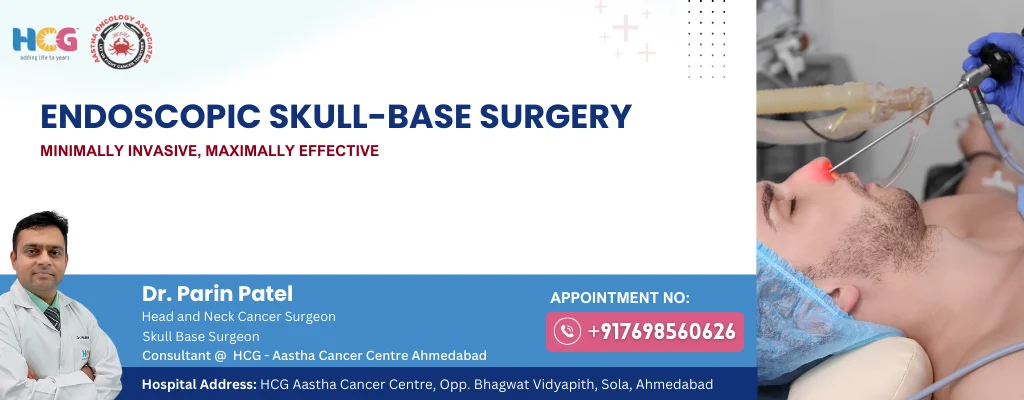
What is endoscopic skull base surgery?
The skull base is the shelf of bone on which the brain rests, separating it from the nose, sinuses, eyes and ears. Tumours here were once reached only by opening the skull or cutting through the face. Endoscopic skull base surgery instead uses the nostrils as a natural corridor: a slim high-definition endoscope provides a magnified view, and long, fine instruments passed beside it remove the tumour from below, without any external incision. It is one form of skull base surgery, chosen when the tumour lies in the midline or close to the sinuses.
The technique is often described as endoscopic endonasal surgery (EES) or the expanded endonasal approach. It is performed by Dr. Parin Patel together with a neurosurgical colleague as a two-surgeon, four-handed team, which is the international standard for these operations.
Conditions treated
Symptoms that may point to a skull base tumour
- Persistent one-sided nasal blockage, discharge or nosebleeds
- Loss of smell
- Headache that is new, progressive or worse on waking
- Visual disturbance, particularly loss of the outer fields of vision, or double vision
- Hormonal changes: irregular periods, milk discharge, growth of hands and feet, weight change, fatigue
- Clear watery fluid dripping from one nostril, especially when bending forward
- Facial numbness, or hearing loss and ringing in one ear
Our article on recognising symptoms that need endoscopic skull base surgery discusses these warning signs in more depth.
Planning the operation
- 01
Detailed imaging
MRI with contrast shows the tumour and its relationship to the optic nerves, carotid arteries and brain. Fine-cut CT maps the bony anatomy of the sinuses for navigation. CT angiography is added when major vessels are involved.
- 02
Endocrine and eye assessment
Hormone tests identify secreting tumours and any deficiencies that must be corrected before surgery. Visual fields and acuity are documented as a baseline.
- 03
Nasal endoscopy
The nasal cavity is examined for anatomy, infection or polyps that would affect the surgical corridor.
- 04
Multidisciplinary discussion
Dr. Patel, the neurosurgeon, endocrinologist, radiation oncologist and radiologist agree on whether an endoscopic, open or combined approach is safest, and whether surgery should be total, subtotal or followed by radiotherapy.
What the surgery involves
Under general anaesthesia, the endoscope and instruments are passed through both nostrils. A corridor is created through the back of the nose, and the sphenoid sinus or other relevant part of the skull base is opened to expose the tumour. Using image-guided navigation, which shows the position of each instrument on the patient's own scans in real time, the tumour is removed piece by piece under high magnification. Doppler ultrasound locates the carotid arteries, and nerve monitoring is used when cranial nerves are at risk.
Once the tumour is removed, the skull base is reconstructed. Small defects are sealed with fat and tissue glue; larger openings are covered with a nasoseptal flap, a piece of the patient's own nasal lining kept alive on its blood supply, which is the key advance that has made extended endonasal surgery safe. There are no external stitches, and nasal packing, if used, is removed within a day or two.
Why Dr. Parin Patel
- Skull Base Surgery Fellowship at Tata Memorial Centre, Mumbai, one of India's highest-volume skull base units
- Head, Neck and Skull Base Surgical Oncologist with more than thirteen years of experience
- Two-surgeon endoscopic team with neurosurgery, supported by navigation and nerve monitoring at HCG Aastha Cancer Centre
- Expertise in both endoscopic and open approaches, so the choice is made on what is safest, not on what is available
- Structured endocrine and ophthalmic follow-up after surgery
Learn more about his training and approach, or see the skull base surgeon page for the wider skull base practice.
Recovery after endoscopic skull base surgery
Most patients are up and walking the day after surgery and go home within three to five days. Nasal congestion, crusting and a reduced sense of smell are expected for several weeks while the nose heals, and are managed with saline rinses and clinic clean-outs. Patients are asked to avoid nose-blowing, straining and heavy lifting for about a month to protect the skull base repair. Hormone levels are checked before discharge and at follow-up, and vision is reassessed. A post-operative MRI at around three months documents the result. Return to office work is usual within two to three weeks.
See how long does recovery take after endoscopic skull base surgery? for a week-by-week guide.
Related care
Patient questions
Frequently asked questions
Related treatments