Thyroid Surgery in Ahmedabad
Careful thyroid surgery in Ahmedabad, planned around voice and nerve preservation.
Thyroid surgery removes part or all of the thyroid gland to treat suspicious nodules, large goitres, overactive glands and thyroid cancer. The operation is safe in experienced hands, but the recurrent laryngeal nerves and parathyroid glands lie millimetres away. Dr. Parin Patel uses meticulous technique and intraoperative nerve monitoring to protect your voice and calcium balance.
Clear decisions
Function-conscious planning
About the thyroid gland
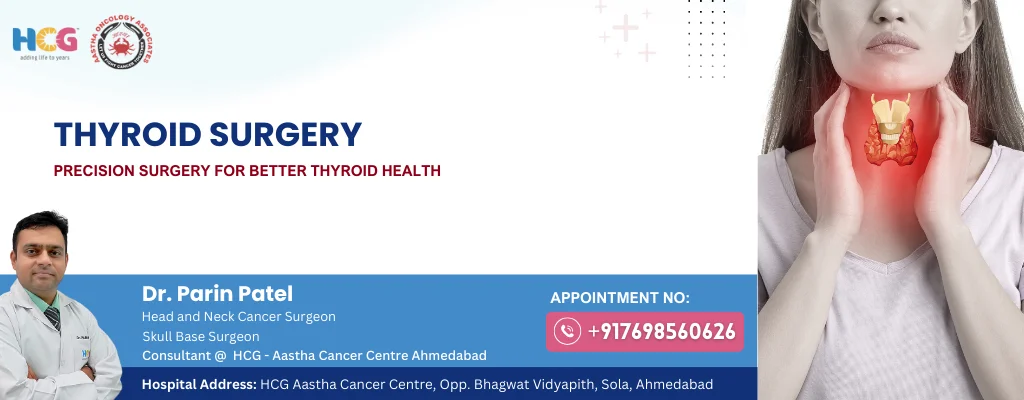
The thyroid is a butterfly-shaped gland at the front of the neck, just below the Adam's apple, that produces the hormones controlling metabolism, heart rate, temperature and energy. Two structures lie in intimate contact with it: the recurrent laryngeal nerves, one on each side, which move the vocal cords, and the four tiny parathyroid glands, which regulate calcium. Safe thyroid surgery is, above all, about protecting these structures while removing the diseased gland completely.
When is thyroid surgery recommended?
Most thyroid problems are managed with medication or observation. Surgery is advised when:
- A nodule is cancerous or suspicious on fine-needle biopsy (Bethesda categories IV to VI), or shows worrying features on ultrasound
- A goitre is large enough to cause difficulty swallowing or breathing, a visible swelling, or extends down behind the breastbone
- An overactive thyroid (Graves' disease or a toxic nodule) is not controlled by medicines or radioiodine, or these are unsuitable, for example in pregnancy or with eye disease
- A nodule keeps enlarging, or a cyst keeps recurring after aspiration
- Thyroid cancer has been confirmed, in which case the extent of surgery is planned as described on our thyroid cancer page
Our articles on thyroid nodules to cancer: when should you really worry? and when to choose thyroid surgery explain how these decisions are made.
Evaluation before surgery
- 01
Blood tests
Thyroid function (TSH, T3, T4), calcium and vitamin D, and thyroid antibodies where relevant. An overactive gland is brought under control with medication before surgery.
- 02
High-resolution ultrasound
Maps every nodule, grades its risk (TIRADS) and examines the lymph nodes of the neck. This is the single most informative test.
- 03
Fine-needle aspiration cytology (FNAC)
Ultrasound-guided sampling of suspicious nodules, reported on the Bethesda scale. Molecular tests may help clarify indeterminate results; see the role of molecular testing in thyroid cancer care.
- 04
Vocal cord check and CT when needed
A quick laryngoscopy documents vocal cord movement before surgery. CT is added for large goitres, retrosternal extension or suspected invasion.
Types of thyroid surgery
How Dr. Parin Patel performs thyroid surgery
The operation is performed under general anaesthesia through a short incision placed in a natural skin crease low in the neck, typically four to six centimetres, which fades to a fine line. Dr. Patel uses magnification, precise energy devices and intraoperative nerve monitoring, which confirms that each recurrent laryngeal nerve is functioning at the end of the procedure. The parathyroid glands are identified and preserved with their blood supply; if one is inadvertently devascularised, it is re-implanted into a muscle where it resumes function. The gland is removed intact, without spilling tissue, and the wound is closed with a dissolving suture beneath the skin.
Why choose Dr. Parin Patel for thyroid surgery
- Head and Neck Surgical Oncologist with more than thirteen years of experience and fellowship training in Head and Neck Oncology
- High-volume thyroid and parathyroid surgery at HCG Aastha Cancer Centre, Ahmedabad, including complex retrosternal goitres and re-operations
- Routine intraoperative nerve monitoring and parathyroid preservation
- Cosmetically placed incisions and meticulous closure
- Seamless pathway to endocrinology, nuclear medicine and lifelong follow-up when cancer is found
Read more on the about page, and in our overview thyroid surgery in Ahmedabad: evaluation, procedures and modern surgical care.
Recovery after thyroid surgery
Most patients stay in hospital for one night and go home the next morning. A normal diet and gentle activity resume immediately; there are no drains in most cases. Mild neck discomfort and a slight sore throat settle within days. Calcium levels are checked after total thyroidectomy, and short-term calcium and vitamin D supplements are given if needed. Thyroxine tablets begin the day after total thyroidectomy. Patients typically return to desk work within a week and to full activity within two weeks. The final pathology report is reviewed at follow-up, and a long-term plan is made accordingly.
Our guide thyroid surgery in Ahmedabad: everything you need to know walks through the whole journey from first visit to recovery.
Related care
Patient questions