
Oral Cancer Surgery Specialist in Ahmedabad
Precise oral cancer surgery in Ahmedabad, with reconstruction planned from day one.
Oral cancer affects the tongue, cheek lining, gums, jaw and lips, and is among the most frequently diagnosed cancers in India. Treated early, the chances of cure are much better. Dr. Parin Patel specialises in oncologically complete resection, compartment neck clearance and microvascular reconstruction, with the aim that patients regain speech, swallowing and facial appearance alongside disease control.
Clear decisions
Function-conscious planning
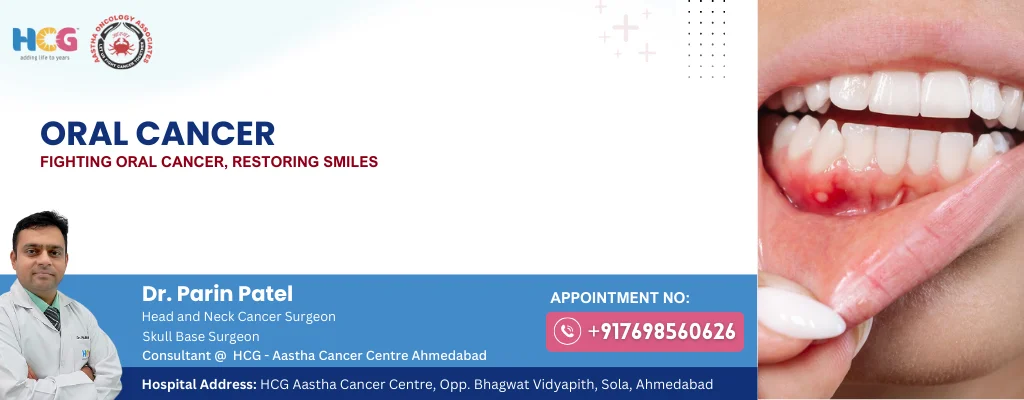
What is oral cancer?
Oral cancer, also called oral cavity cancer, is a malignant growth that begins in the lining of the mouth. It can arise on the tongue, the inner cheek (buccal mucosa), the gums, the floor of the mouth, the hard palate, the lips or the area behind the wisdom teeth. More than nine in ten cases are squamous cell carcinomas, which start in the flat surface cells of the mouth lining and can invade deeper muscle and bone, then spread to the lymph nodes of the neck.
India carries one of the highest burdens of oral cancer in the world, and Gujarat is among the most affected states because of widespread tobacco chewing, gutkha and areca nut use. The encouraging news is that the mouth is easy to examine: most oral cancers are visible or palpable long before they spread, and an early-stage tumour treated properly has a much better chance of cure.
Symptoms and warning signs
Early oral cancer is frequently painless, which is why it is so often ignored. Any of the following that lasts longer than three weeks should be examined by a specialist:
- An ulcer or sore in the mouth that does not heal
- A white patch (leukoplakia) or red patch (erythroplakia) on the tongue, cheek or gums
- A lump, thickening or rough area inside the mouth or on the lip
- Difficulty opening the mouth fully (trismus), often from long-term areca nut use
- Loose teeth, or a socket that does not heal after extraction
- Pain, numbness or burning in the mouth, or ear pain on one side
- Difficulty chewing, swallowing or moving the tongue or jaw
- A persistent lump in the neck, which can be the first sign of spread to lymph nodes
Dentists often notice the earliest changes during routine check-ups. Our article on early oral cancer signs dentists detect explains what they look for and why a dental referral should never be delayed.
Causes and risk factors
Oral cancer rarely appears without a cause. The most important risk factors, several of which are common in Gujarat, are:
Cases in people who have never used tobacco are also rising. Our guide to mouth cancer in young adults and non-smokers explores why, and our lifestyle tips to prevent oral cancer set out practical steps for reducing risk.
When Should You See an Oral Cancer Doctor in Ahmedabad?
Not every change in the mouth is cancer. Some conditions are not cancer but carry a higher chance of turning into cancer over time, particularly with continued tobacco or areca nut use. Doctors call these oral potentially malignant disorders. Seeing an oral cancer doctor in Ahmedabad for any of the changes below allows the condition to be identified and, where needed, monitored or treated early.
| Condition | What it may look or feel like | What is usually advised |
|---|---|---|
| Leukoplakia | A white patch that cannot be rubbed off | Stopping tobacco, regular review, and a biopsy if the patch is thick, irregular or changing |
| Erythroplakia | A red, velvety patch | A biopsy is usually advised, as these patches carry a higher risk of change |
| Oral submucous fibrosis | Stiff cheeks, reduced mouth opening, burning with spicy food | Stopping areca nut and gutkha, treatment to improve mouth opening, and regular review |
| Oral lichen planus (some forms) | Lacy white lines or sore red areas inside the cheeks | Regular review, and a biopsy if the appearance changes |
| Non-healing ulcer | A mouth ulcer lasting more than three weeks | Examination and, usually, a biopsy |
Having one of these conditions does not mean cancer will develop. Many remain stable, particularly once tobacco and areca nut use stop. Regular mouth examination by a dentist or doctor helps spot changes early. For more, see early oral cancer signs dentists detect, smokeless tobacco and oral cancer and the early signs and screening guide.
How oral cancer is diagnosed and staged
A confident treatment plan depends on knowing exactly how large the tumour is, how deeply it has invaded and whether the neck is involved. Dr. Parin Patel follows a structured diagnostic pathway at HCG Aastha Cancer Centre:
- 01
Clinical examination
A detailed inspection and palpation of the entire mouth, throat and neck, including a fibre-optic check of the pharynx and larynx to rule out a second tumour.
- 02
Biopsy
A small piece of the suspicious area is removed under local anaesthesia and examined by a pathologist. This confirms the diagnosis and the type of cancer. New approaches such as liquid biopsies are also being studied for early detection.
- 03
Imaging
Contrast CT or MRI of the face and neck maps the depth of invasion, bone involvement and lymph nodes. A PET-CT is added for advanced disease to check for distant spread.
- 04
Staging and tumour board
The findings are combined into a TNM stage (I to IV) and discussed with radiation and medical oncologists, so that surgery, radiotherapy and chemotherapy are sequenced correctly for your case.
Oral Cancer Specialist in Ahmedabad: The Team Involved in Your Care
Oral cancer treatment involves more than one specialist. As an oral cancer specialist in Ahmedabad, the head and neck surgical oncologist leads the surgical plan, while other members of the team handle imaging, pathology, further treatment and recovery. Each case is discussed at the tumour board so that these steps are planned together.
| Team member | Role in oral cancer care |
|---|---|
| Head and neck surgical oncologist | Removes the tumour, carries out the neck dissection and plans reconstruction |
| Radiologist | Reads the CT, MRI or PET-CT scans that show the tumour's depth, bone involvement and lymph nodes |
| Pathologist | Examines the biopsy, the margins and the lymph nodes, which guides any further treatment |
| Radiation oncologist | Plans radiotherapy when it is needed after surgery or as the main treatment |
| Medical oncologist | Advises on chemotherapy or other cancer medicines in selected cases |
| Dental surgeon or prosthodontist | Checks the teeth before radiotherapy and helps with dentures or dental rehabilitation after jaw surgery |
| Speech and swallowing therapist | Supports recovery of speech and swallowing |
| Dietitian | Plans nutrition before and after surgery, including tube feeding if needed |
Read more about nutrition before and after mouth cancer surgery and rehabilitation.
Oral cancer treatment in Ahmedabad
Surgery is the primary treatment for most oral cancers, because it aims to remove the tumour completely in a single sitting and gives the pathologist a full specimen to assess. Radiotherapy, with or without chemotherapy, is added after surgery for larger tumours, close margins, lymph node spread or aggressive features. Dr. Patel's surgical approach has three components, planned together before the first incision:
1. Complete removal of the primary tumour
The tumour is excised with a cuff of healthy tissue around it, known as a clear margin. Depending on the site, this may be a wide local excision of the cheek, a partial glossectomy of the tongue, a marginal mandibulectomy that removes only the rim of the jaw, or a segmental mandibulectomy when the bone is invaded. Frozen-section analysis during the operation checks that margins are free before reconstruction begins. Our article on why clear margins matter explains the principle.
2. Management of the neck
Oral cancers spread first to the lymph nodes in the neck, sometimes before any node can be felt. A neck dissection removes the at-risk nodes in a systematic, compartment-based clearance while preserving the nerves, muscles and veins that are not involved. Dr. Patel received the gold medal at FHNO Kolkata in 2018 for his work on compartment clearance, and applies the same discipline to every case. See why lymph node removal matters.
3. Reconstruction in the same operation
Wherever tissue has been removed, it is rebuilt immediately, from a local flap for small defects to a microvascular free flap that transfers skin, muscle or bone with its own blood supply for larger ones. A fibula free flap can rebuild the jaw, and a radial forearm flap can restore the tongue or cheek. Reconstruction helps protect speech, swallowing and facial appearance and is described in depth on our reconstructive surgery page and in restoring function and appearance after oral cancer surgery.
Neck Dissection Surgery in Ahmedabad: Types and Recovery
Neck dissection surgery in Ahmedabad is often part of oral cancer treatment, even when no lump can be felt in the neck. This is because cancer cells can reach the lymph nodes before they are large enough to feel or see on a scan. The decision depends on the tumour's size, depth and site, and on what the scans show. The removed nodes are examined by the pathologist, which helps decide whether radiotherapy or chemotherapy is needed afterwards.
| Type of neck dissection | What is removed | When it may be used |
|---|---|---|
| Selective neck dissection | Only the lymph node groups at highest risk, most often in the upper neck for oral cancer | When no nodes are felt, but there is a risk of hidden spread |
| Modified radical neck dissection | All main lymph node groups on that side, while preserving one or more of the accessory nerve, internal jugular vein and neck muscle | When cancer has spread to the neck nodes |
| Radical neck dissection | All main lymph node groups along with the accessory nerve, internal jugular vein and neck muscle | When the cancer directly involves these structures; needed less often today |
After a neck dissection, patients can generally expect:
- A drain in the neck for a few days to remove fluid
- Numbness of the skin of the neck and ear lobe, which often improves over months
- Shoulder stiffness or weakness in some patients, which physiotherapy helps
- Swelling under the chin and jaw, which settles gradually
- A discussion of the pathology results, which guide any further treatment
Read more about neck dissection for tongue cancer and neck lymph node removal. For a wider view, see an overview of head and neck cancer surgery and treatment.
Dr. Parin Patel's Training and Approach to Oral Cancer Surgery
Dr. Parin Patel is a fellowship-trained Head, Neck and Skull Base Surgical Oncologist with more than thirteen years of experience, practising at HCG Aastha Cancer Centre, Ahmedabad. After an MS in Otorhinolaryngology, he completed a fellowship in Head and Neck Oncology and later a Skull Base Surgery fellowship at Tata Memorial Centre, Mumbai. Oral cancer forms the largest part of his practice.
- Margin-focused surgery with intraoperative frozen-section control to minimise recurrence
- Compartment neck dissection technique; FHNO gold medal, Kolkata 2018, for work on compartment clearance
- Resection and reconstruction planned together, so function can be protected rather than repaired later
- Tumour board review for every patient, bringing radiation and medical oncology into the plan
- Structured rehabilitation with speech, swallowing and nutrition support from the first week
- Transparent guidance on oral cancer surgery cost in Ahmedabad before treatment begins
You can read more about his training and approach on the about Dr. Parin Patel page.
Recovery after oral cancer surgery
Most patients stay in hospital for five to ten days depending on the extent of surgery and whether a free flap was used. A temporary feeding tube protects the healing mouth for the first one to two weeks; a temporary tracheostomy is occasionally needed for larger operations and is usually removed before discharge. Swelling settles over three to four weeks, and adjuvant radiotherapy, when needed, usually begins four to six weeks after surgery.
Recovery does not end with wound healing. Speech and swallowing therapy, jaw-opening exercises, dental rehabilitation and nutritional support are built into the plan through our head and neck cancer rehabilitation programme. Practical advice on eating is covered in nutrition and taste rehabilitation after oral cancer surgery.
Follow-up visits are scheduled every one to three months in the first two years, when the risk of recurrence is highest, then less frequently. Stopping tobacco and alcohol completely is the single most important thing you can do to prevent a second cancer.
Oral Cancer Surgeon in Ahmedabad: Questions to Ask Before Surgery
The operation an oral cancer surgeon in Ahmedabad recommends depends mainly on where the tumour is and how deeply it has spread. The table gives a general overview; the exact plan is decided for each patient after the scans and the biopsy.
| Tumour site | Common operation | Usual reconstruction options |
|---|---|---|
| Tongue | Partial or hemi-glossectomy | Direct closure for small defects, or a free flap from the forearm or thigh |
| Inner cheek (buccal mucosa) | Wide local excision, sometimes with removal of the jaw rim | Local or regional flap, or a free flap |
| Lower gum and jaw | Marginal or segmental mandibulectomy | A fibula free flap when a segment of the jaw is removed |
| Floor of the mouth | Wide local excision, often with neck dissection | Free flap from the forearm in many cases |
| Upper gum and hard palate | Partial maxillectomy | A dental obturator (prosthesis) or a free flap |
| Lip | Wedge excision or wider excision | A local flap from the lip or cheek |
Questions you may want to ask your surgeon before agreeing to surgery:
- What is the stage of my cancer, and what do the scans show?
- What will be removed, and will my jaw or tongue be affected?
- Will I need a neck dissection or reconstructive surgery?
- What are the possible risks and side effects?
- How long will I stay in hospital, and when can I start eating and speaking again?
- Will I need radiotherapy or chemotherapy afterwards?
- What are the alternatives to surgery?
For cancers of the gum, cheek, lip and palate, see the mouth cancer page. You can also read what patients need to know about mouth cancer surgery and care tips after mouth cancer surgery.
Related conditions and care
Patient questions