
Pharyngeal Cancer
Neck Lump With No Obvious Cause: Could It Be Pharyngeal Cancer?
You notice a small lump on the side of your neck. It does not hurt. You have no fever, no cold and no sore throat. Weeks go by and the lump is still there.

You notice a small lump on the side of your neck. It does not hurt. You have no fever, no cold and no sore throat. Weeks go by and the lump is still there.
Most neck lumps are harmless, and infections are the most common reason. But a lump that stays for more than three weeks with no clear cause should be examined. Sometimes it is the first and only sign of a small cancer hiding in the throat. A pharyngeal cancer surgery specialist looks for exactly this kind of hidden tumour. You can read about pharyngeal cancer surgery and treatment in detail on our treatment page.
This guide explains why a neck lump can point to the throat, which tests find the source, and when to see a specialist.
Why Do Neck Lumps Happen?
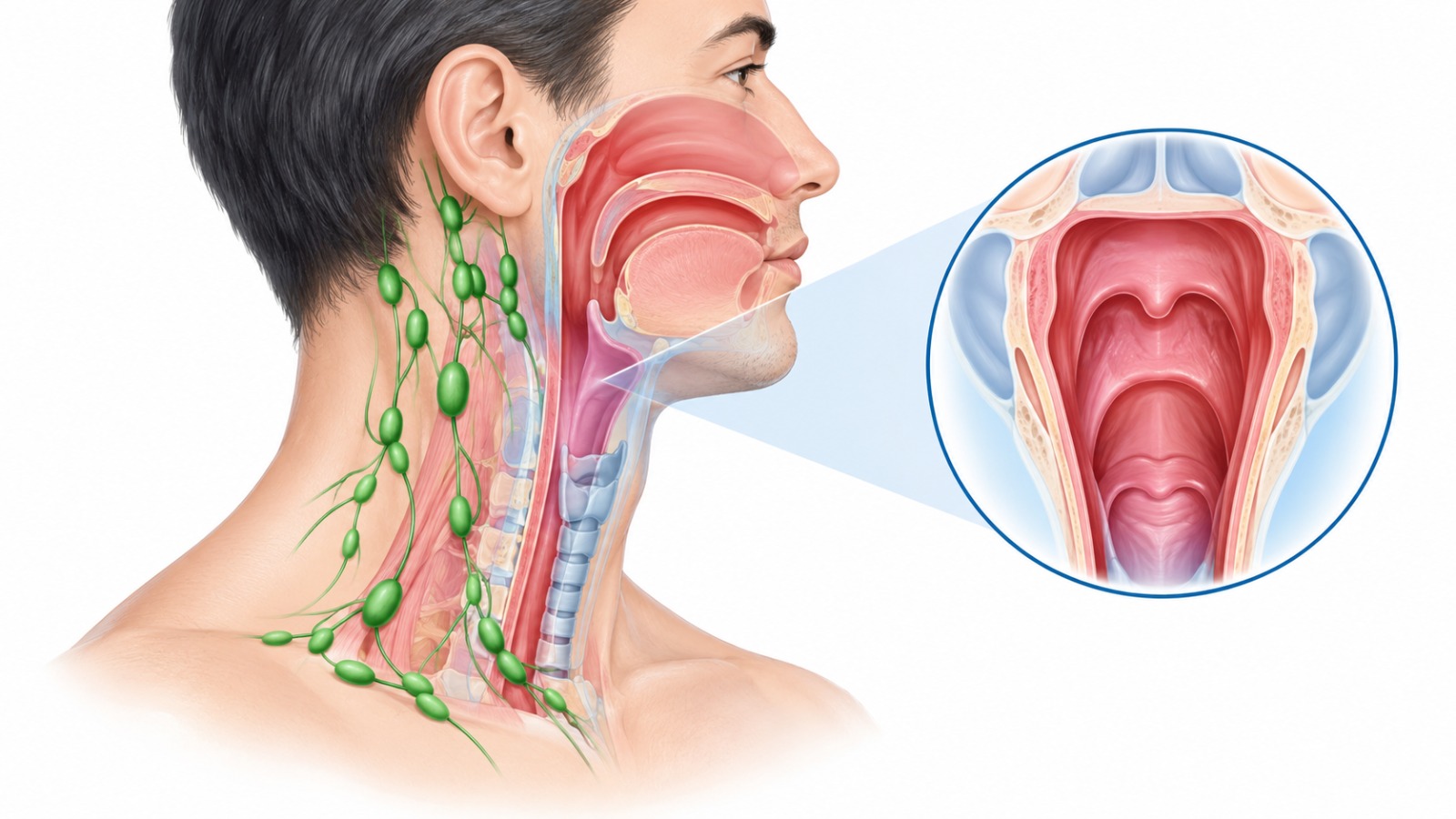
The neck has many lymph nodes. They are small filters that swell when they fight infection or trap abnormal cells. A lump in the neck can come from many causes, and only some of them are cancer.
| Cause | What it usually looks like | Notes |
|---|---|---|
| Infection (throat, tooth, ear, skin) | Tender, soft, often appears with fever or sore throat | Shrinks once the infection settles |
| Tuberculosis of the lymph node | Slowly growing, painless lumps, sometimes several together | Common in India, needs testing to confirm |
| Thyroid swelling or nodule | Lump moves up and down when you swallow | Needs thyroid tests and ultrasound |
| Cyst from birth | Soft, smooth lump, may suddenly grow after a cold | Often found in young adults |
| Salivary gland problem | Swelling below the jaw or near the ear | Related to stones, infection or tumours |
| Lymphoma | Painless, rubbery lumps, sometimes with night sweats or weight loss | Needs a tissue sample |
| Spread from a head and neck cancer | Hard, painless, does not shrink | The primary tumour may be small and hidden |
If your lump is on the side of the neck and has no pain, redness or fever, it deserves a closer look.
When a Neck Lump Becomes a Warning Sign
Please see a doctor if the lump has any of these features:
- It has lasted more than three weeks
- It feels hard or fixed, and does not move easily under the skin
- It is painless but slowly getting bigger
- It appears in an adult who smokes, chews tobacco or drinks alcohol
- It comes with a persistent sore throat, ear pain on one side, or a change in voice
- It comes with difficulty or pain in swallowing, or a feeling of food sticking
- It comes with a blocked nose, nosebleeds or hearing loss in one ear
- It comes with unexplained weight loss
A lump alone does not mean cancer. But the combination of a lump and any of these signs should not be ignored. Our guide on early throat cancer symptoms you shouldn't ignore lists more of these signs.
How Can Pharyngeal Cancer Cause a Neck Lump First?
The pharynx is the muscular passage behind the nose and mouth. Cancers here, especially those caused by HPV, often send cells to the neck nodes early, while the main tumour is still tiny. So the lump in the neck may be the first thing a person notices.
The main tumour can be hard to see because it hides in folds and crevices.
| Hidden site | Why it is hard to see | Cancer link |
|---|---|---|
| Tonsil | Cancer can sit deep inside the tonsil folds | HPV-related oropharyngeal cancer |
| Base of the tongue | Out of sight at the back of the tongue | HPV-related and tobacco-related cancer |
| Nasopharynx | Behind the nose, needs a scope to see | Epstein-Barr virus related cancer |
| Hypopharynx | Lowest part of the throat, wraps around the voice box | Mostly tobacco and alcohol related |
If you want to understand more about HPV-linked cancers, read our blog on the link between HPV and throat cancer. For a related early sign, see one-sided tonsil enlargement as a cancer sign.
Which Tests Find the Cause?
The aim is to find out what the lump is and where it came from. A careful workup usually follows this order.
| Test | Why it is done | What it shows |
|---|---|---|
| Clinical examination | To check the lump, mouth, throat and neck | Size, hardness, and whether it is fixed |
| Flexible nasal endoscopy | A thin camera passed through the nose | The nasopharynx, tonsils, tongue base and lower throat |
| Ultrasound of the neck | To look at the lump and nearby nodes | Whether it is solid, cystic or suspicious |
| Needle test (FNAC) | A thin needle takes cells from the lump | Whether cancer cells are present |
| HPV (p16) and EBV testing | Done on the sample | The likely source and type of cancer |
| MRI or CT scan | To map the throat and neck | Hidden tumours and the spread to nodes |
| PET-CT | Used if the source is still not found | Small areas of cancer activity |
Dr. Parin Patel performs a throat endoscopy at the first visit, so the main areas can be checked on the same day.
Why You Should Not Have the Lump Cut Out First
Many patients are advised to remove the lump quickly. When cancer is suspected, this is usually not the right first step. Cutting into a cancerous node before the work-up can spread cells into nearby tissue and make later treatment harder.
The safer order is endoscopy, a needle test and scans first. The surgeon then decides how the node should be dealt with. Our blog on neck lymph node removal in throat cancer surgery explains when and how this is done.
What If the Main Tumour Is Not Found Right Away?
Sometimes cancer cells are found in the neck node, but scans do not show the main tumour. This is called a cancer of unknown primary. It sounds frightening, but there is a clear way forward.
The next steps usually include:
- Examination under anaesthesia: the throat is checked closely while the patient is asleep
- Directed biopsies: small samples from the nasopharynx, tonsils and base of the tongue, which are the usual hiding places
- Tonsil or tongue base removal for testing: in selected cases, a surgeon can remove the tonsil or part of the tongue base through the mouth to look for a tiny tumour
- A repeat PET-CT: this may be done again if the first scan is unclear
When the source is found, treatment is planned for that site. When it is not, treatment is still possible and usually involves surgery to the neck, radiotherapy, or both, depending on the reports.
What Happens After Diagnosis?
If pharyngeal cancer is confirmed, the treatment depends on the exact site, the stage and the HPV status. It may include transoral surgery, neck dissection, radiotherapy and chemotherapy. HPV-related cancers often respond well to treatment. A tumour board meeting helps plan the safest option for swallowing and speech.
You can read how these symptoms can affect eating in our guide on difficulty swallowing and pharyngeal cancer.
When to See a Pharyngeal Cancer Surgery Specialist
See a specialist if your neck lump has lasted over three weeks, keeps growing, feels hard, or comes with throat, ear or swallowing symptoms. Seeing the right doctor early saves time and avoids repeated tests.
Dr. Parin Patel is a fellowship-trained head, neck and skull base surgical oncologist and robotic surgeon at HCG Aastha Cancer Centre, Sola, Ahmedabad. He treats cancers of the nasopharynx, oropharynx and hypopharynx, and reviews each case with a multidisciplinary tumour board. You can read more about him on the page for a head and neck cancer surgeon in Ahmedabad.
Patients travel from other cities for a second opinion. Please carry your scans, needle test reports and any previous prescriptions. To book a consultation, call +91 76985 60626 or contact the clinic.
Frequently Asked Questions
Can a neck lump be the first sign of pharyngeal cancer?
Yes. In some people, especially with HPV-related or nasopharyngeal cancers, a painless neck lump is the first sign, while the main tumour is still small.
How long should I wait before seeing a doctor about a neck lump?
If a lump lasts more than three weeks, or keeps growing, get it checked. Do not wait for pain, as cancer lumps are often painless.
Is every hard neck lump cancer?
No. Tuberculosis, other infections, cysts and thyroid problems can also cause lumps. But a hard lump that does not go away needs proper tests to find out the cause.
Can a lump be tested without removing it?
Yes. A fine needle test (FNAC), often done with an ultrasound, can check the lump with a small needle. This is usually the first step.
What if scans do not show any tumour in the throat?
The throat may still be examined under anaesthesia, with biopsies from the usual hiding places. A PET-CT or a transoral procedure may also help find the source.
Is a neck lump from pharyngeal cancer curable?
Many pharyngeal cancers are highly treatable when found early, and HPV-related cancers respond especially well. The outlook depends on the site and stage, which your tests will clarify.
Final Thoughts
A neck lump with no clear cause is often harmless, but it should never be ignored for months. The right tests can find the answer quickly, and early action gives you the widest range of treatment choices. If your lump has stayed for more than three weeks, book an examination and carry your reports along.
This article provides general medical education and does not replace an individual examination or treatment recommendation.